

Sell Your DVC Contract Fast
To sell your DVC contract fast, price it within a few dollars per point of recent closed sales for your resort and use year, list with a broker who is paid only at closing, and have your deed, member number, and dues status ready before you sign anything.
Done right, a contract goes pending in about 38 to 44 days on average, Disney’s ROFR review adds roughly 30 days, and a fast sale reaches payout in about 60 to 75 days.
Before I was a resale broker, I spent years on the other side of the desk as a DVC Sales Guide at the Disneyland Resort, selling memberships direct for Disney. That job taught me how Disney thinks about its own inventory, and that thinking is what drives ROFR. Today I help owners sell, and the question I hear most is some version of “how fast can this happen?”
This guide answers the questions sellers ask in the order they usually ask them: how long it takes, how to price, which broker setup helps, what ROFR adds, and what paperwork to gather. Terms in gold link to plain-English definitions.

How long does it take to sell a DVC contract right now?
Across 2026 market reports published by DVC resale brokerages, the average time from listing to pending has held at roughly 38 to 44 days. One brokerage measured 41 days in February with a sale-to-list ratio near 93.7%, and its August update showed well-priced contracts moving in about 38 days.
Low supply is a big part of that. One industry count found only about 263 active resale listings across the major brokerages in April 2026, roughly half the usual level. Fewer listings means buyers act faster when a fairly priced contract shows up.

Kenny at the Disneyland Resort, where he sold DVC direct for Disney before becoming a resale broker.
| Contract type | Typical days to pending | Why |
|---|---|---|
| High-demand resorts (for example Grand Californian, Polynesian, Bay Lake Tower) | 15-25 days | Thin inventory and buyers waiting for these resorts |
| Mid-tier Walt Disney World resorts | 30-45 days | Normal supply, buyers comparing use years and point status |
| Higher-inventory resorts (for example Saratoga Springs, Old Key West, Vero Beach, Hilton Head) | 45-60 days | More listings competing for the same buyers |
Ranges reflect published 2026 brokerage market data. They describe the market, not a promise for any one contract.
“Days on market stops counting when a buyer signs. When a seller asks me how fast, I give them two numbers: days to an accepted offer, and days to money in the bank.”
Step 3 is the only stretch you can’t speed up. Every other step moves faster when your pricing and paperwork are ready on day one.
What price adjustments (per point) speed up a sale?
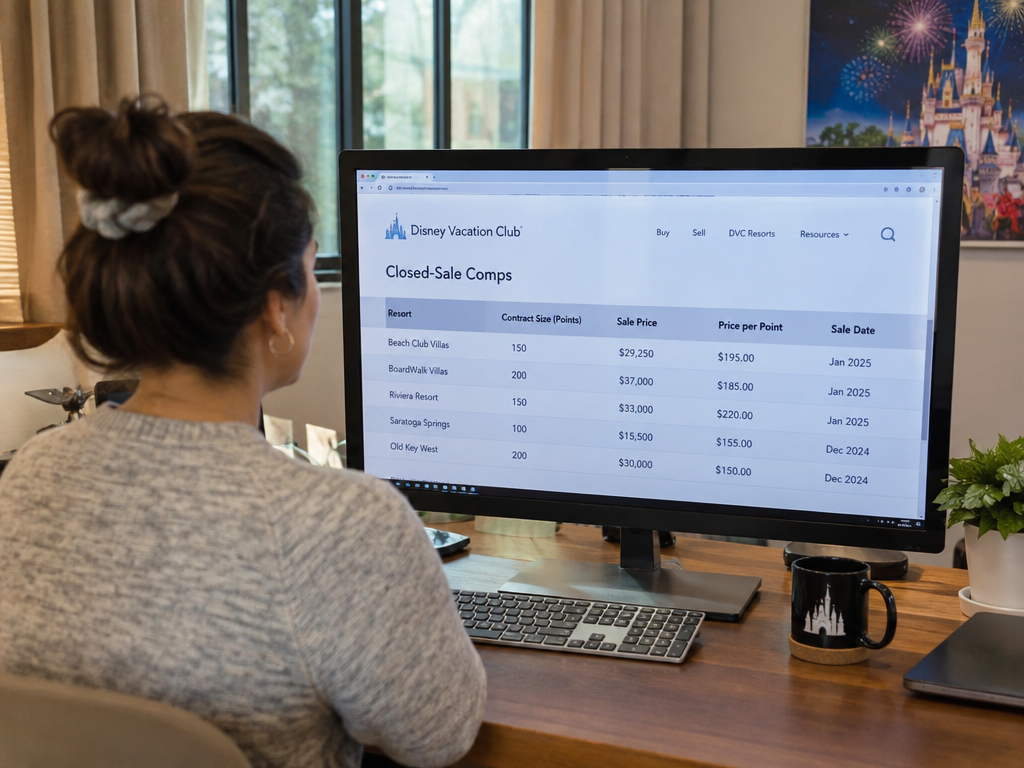
Price is the biggest lever you have. One brokerage’s monthly report put the blended average resale price at about $128 per point in August 2026, up from $124 in June, as thin inventory pushed prices up.
That’s good news for sellers. But buyers don’t shop the blended average. They shop by resort, use year, contract size, and whether the contract is loaded or stripped.
The pricing rules I give every seller:
- Price off closed sales, not active listings. Asking prices tell you what other sellers hope to get. Closed sales tell you what buyers paid.
- Match your exact profile. Same resort, same use year, similar size, similar point status.
- Leave normal negotiating room, not extra. Contracts close at about 93.7% to 95% of list. List 10% over the comps and buyers won’t negotiate you down. They’ll scroll past you.
- Adjust in $3 to $5 per point steps, on a schedule you set before listing. No serious inquiries in 14 days, take the first step. No offer by day 30, move to the middle of recent closed sales.
- Don’t race to the bottom. Pricing well under market is what invites Disney to exercise ROFR.
| List price | Sale price | 9% commission | Your net | Cost of the cut |
|---|---|---|---|---|
| $130/pt | $19,500 | $1,755 | $17,745 | Starting point |
| $125/pt | $18,750 | $1,687.50 | $17,062.50 | $682.50 |
| $120/pt | $18,000 | $1,620 | $16,380 | $1,365 |
Compare that to the cost of waiting. Annual dues are prorated at closing, so a few extra months on the market costs you only those months of dues. At an illustrative $9.50 per point per year, that’s about $119 a month on 150 points.
So when does a cut pay off? When you’re priced above comparable sales and your current-year points are close to expiring. A contract that loses its usable points becomes stripped, and stripped contracts usually have to drop more per point than the $5 cut that would have sold them while loaded. If you’re already priced at the comps, a cut buys you very little speed.
Example figures are for illustration only. Your commission rate, dues, and resort pricing will differ.
Which broker commission structures reward faster sales?
Most DVC resale brokers are paid a percentage of the sale price, taken from your proceeds at closing. Published 2026 seller rates from large brokerages run about 8.5% to 10%, and at least one discount model charges 6.9%. Some companies skip commission and charge a flat advertising fee upfront instead.
The structure matters more than the headline rate, because it decides whether your broker has a reason to get you to the closing table quickly.
| Structure | How the broker is paid | Reason to sell fast? | Watch for |
|---|---|---|---|
| Full-service percentage (about 8.5-10%) | Only if the sale closes | Strong | Long listing terms, extra buyer admin fees |
| Lower percentage (about 6.9%) | Only if the sale closes | Strong, and you can list lower for the same net | How many buyers see your listing |
| Flat advertising fee | Upfront, whether it sells or not | Weak | Non-refundable fees, you negotiate yourself |
| For sale by owner | No broker | Depends on you | ROFR submission, title, and payment fraud risk all land on you |
To walk away with $17,550 from a 150-point contract, here’s the sale price you’d need at each commission rate:
A lower commission lets you price $2 to $4 per point under the field without netting less. That’s about the size of a typical first price step.
Questions to ask any broker before you sign, including us:
- ✓ Is the commission paid only at closing, with nothing due upfront?
- ✓ How long is the listing agreement, and can I cancel if it isn’t working?
- ✓ Do buyers pay an extra admin fee on your listings? That raises their total cost and can slow offers.
- ✓ How many active buyers are waiting for my resort and use year?
- ✓ How quickly do you submit to Disney after the agreement is signed?
- ✓ Which title company do you use, and do they offer remote online notarization?
What does ROFR add to the timeline, and can it be shortened?
Every DVC resale goes through Disney’s Right of First Refusal (ROFR). After your purchase agreement is signed and submitted, Disney reviews the deal and either waives (your sale moves forward) or exercises (Disney buys the contract at the same price and terms). Brokers report the review usually takes 21 to 35 days, and most plan around 30. Owner-reported timelines show some longer waits, especially when the scheduled closing date sits well past day 30.
Can you shorten it? Not directly. There’s no expedite fee and no seller form that speeds up Disney’s review. What you control is everything around it:
The ROFR fact most sellers miss
For a buyer, ROFR is a risk. For you as the seller, an exercise is not a lost sale. Disney buys your contract at the price you agreed to, and you still get paid. The main difference is that Disney closes through its own title process, so your timing can shift.
Exercise rates have been low lately. One brokerage reported Disney took just 2 of 100 contracts in October 2026, and resorts with resale restrictions like Riviera see very little ROFR activity. Having sold memberships direct for Disney, I think of it this way: Disney steps in when a resale price is low enough that buying the points back makes sense for them. Price to the market and that rarely happens.
What documents should a DVC seller have ready?
This is where fast sales are won or lost. Hunting for paperwork after you have an offer costs days at every step. Gather this before you sign a listing agreement:
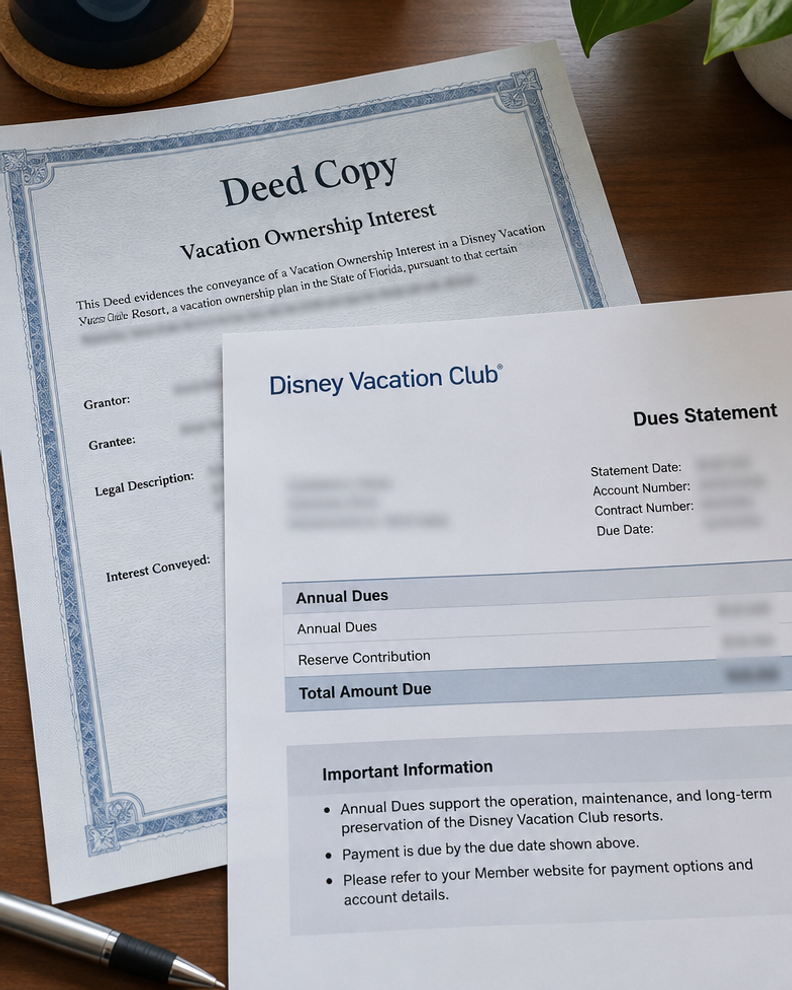
- ✓ Recorded deed copy. Can’t find it? The title company can usually pull it from county records.
- ✓ Member number and contract number for each contract.
- ✓ Home resort, use year, and total points.
- ✓ Point status: current, banked, borrowed, and any booked reservations.
- ✓ Dues status and your latest dues statement.
- ✓ Exact legal names on the deed, plus contact info for each signer.
- ✓ Loan payoff statement if still financed.
- ✓ Photo ID for every signer, for notarization.
- ✓ If they apply: trust documents, power of attorney, estate paperwork, or name-change records.
What about the estoppel? You don’t order it yourself. After ROFR clears, the title company requests an estoppel from Disney, which confirms ownership, points, and dues status. Disney charges a $150 estoppel fee, normally paid by the seller from proceeds. One brokerage puts estoppel turnaround at about 2 to 4 weeks after ROFR, and owners commonly report slower turnarounds in December, when Disney is processing annual dues.
One point for every row where you’re in the left column. Six or more and you’re set up for a fast sale. Four or fewer, fix what you can before listing.
| Sells faster | Sells slower |
|---|---|
| Current-year points available to use | Stripped, with no points until next use year |
| Priced within 2-3% of recent closed sales | Priced 10% or more above them |
| Mid-size contract (about 100-200 points) | Very large contract with a smaller buyer pool |
| Dues paid and current | Dues past due |
| One or two signers who respond quickly | Several owners in different states, or an estate in probate |
| Deed and member info ready on day one | Paperwork gathered after an offer arrives |
| High-demand or mid-tier resort | Resort with heavy resale inventory |
| Broker paid only at closing | Upfront fee with no closing incentive |
Selling in late 2026: timing notes


Listing before the holidays? Plan for slower December paperwork.
- ✓ December estoppels run slow. Sign in early December and expect title work to stretch into January.
- ✓ Dues straddle the year. Dues are prorated at closing, so a 2027 closing splits 2027 dues between you and the buyer. Your agreement should spell out how.
- ✓ Use the $500 fee as an incentive. Since January 1, 2026, Disney charges a $500 Contract Administration Fee on every resale closing, and the agreement decides who pays. Covering it works out to about $3.33 per point on 150 points, often a cleaner offer than a price cut because your listed price stays at the comps.
- ✓ Check your banking deadline. Unused points about to expire can often be banked into next year, which keeps them available to the buyer and protects your price.
My bottom line on selling fast
Fast and fair aren’t opposites in this market. Inventory is low and prices have been climbing, so a contract priced to recent closed sales, with paperwork ready and points intact, should not sit. Most slow sales I see come down to one of three things: a price set off hopeful listings instead of closed sales, missing documents, or a broker setup that doesn’t reward closing.
After 13+ years in Disney Vacation Club sales, first for Disney and now for owners, my advice is simple: get your numbers right before you list, not after the first month of silence.
Want to know what your contract would sell for today?
I’ll run a pricing check against current closed sales for your resort and use year.
Seller terms in 30 seconds
Disney’s right to buy a resale contract at the agreed price.
Estoppel →
Disney’s confirmation of ownership, points, and dues at closing.
Loaded vs. stripped →
Whether the contract still has usable points this year.
Use year →
The 12-month period your points are valid.
Banking and borrowing →
Moving points forward or back a year.
Contract Administration Fee →
Disney’s $500 charge on every resale closing.
Frequently asked questions
How long does it take to sell a DVC contract in 2026?
Well-priced contracts are going from listing to pending in about 38 to 44 days on average, faster at high-demand resorts. Add roughly 30 days for Disney’s ROFR review and 2 to 5 weeks for title work. A fast sale is about 60 to 75 days from listing to payout.
Can I sell my DVC contract directly back to Disney?
Disney does not run a buyback program for owners. The only way Disney buys a resale contract is by exercising its Right of First Refusal on a deal you’ve already signed with a buyer. When that happens, Disney pays the same price your buyer agreed to.
Who pays the $500 DVC Contract Administration Fee?
The purchase agreement decides. Many deals assign it to the buyer, but a seller can offer to cover it as an incentive. Separately, the $150 Disney estoppel fee is normally paid by the seller.
Do I need my original deed to sell my DVC contract?
A copy is enough to get started, and the title company can usually pull the recorded deed from county records. What you do need are your member number, contract number, and the exact names of everyone on the deed.
Does lowering my price make Disney more likely to exercise ROFR?
Yes. Disney tends to exercise on contracts priced well below recent sales for that resort. If it does, you still sell at your agreed price, but the closing moves to Disney’s process and your original buyer is out of the deal.

Kenny is the broker behind DVC Magical Vacation Pros (CA DRE #01726372, Florida Licensed Real Estate Broker). As a former DVC Sales Guide at the Disneyland Resort, he earned multiple Leadership Circle Awards and more than $35 million in direct DVC sales. He has 13+ years in Disney Vacation Club sales and now helps buyers and sellers nationwide from Garden Grove, California.
.